Jiangxi Copper Company Limited is the largest integrated copper producer in mainland China and a critical player in the global metals supply chain. For investors, it represents a “pure play” on China’s industrial demand and the green energy transition, but with a distinct business model that differs significantly from Western miners like Freeport-McMoRan.
While the company is listed on both the Shanghai Stock Exchange (A-shares: 600362) and the Hong Kong Stock Exchange (H-shares: 0358), the two listings often trade at vastly different valuations, creating specific opportunities and risks for global capital.
Company Overview: The Smelting Giant
Unlike pure mining companies that generate profit primarily from extracting ore, Jiangxi Copper is a smelting and refining giant with integrated mining operations. This distinction is vital for understanding its margin structure.
Business Model Breakdown
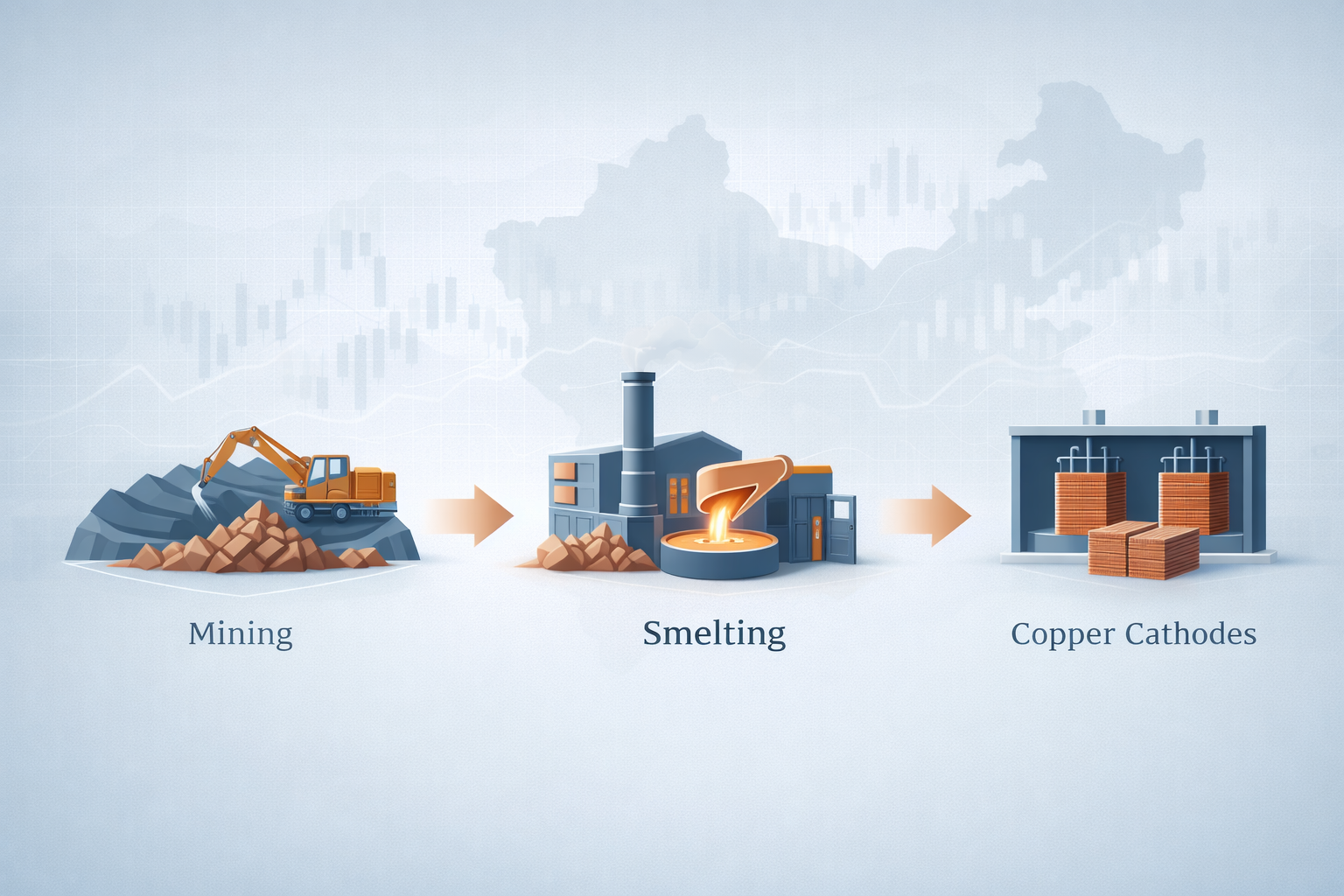
- Mining (Upstream): Jiangxi owns the Dexing Copper Mine, the largest open-pit copper mine in China, along with other domestic mines. However, its self-sufficiency rate is relatively low compared to its smelting capacity. It produces approximately 200,000 tonnes of copper concentrate annually from its own mines.
- Smelting & Refining (Midstream): This is the core volume driver. The company produces over 2.3 million tonnes of copper cathode annually. It purchases copper concentrate from global miners (like BHP or Freeport) and processes it.
- Trading & Processing (Downstream): A significant portion of its revenue comes from its trading arm and copper processing (rods, wires, foils).
Key Takeaway: Jiangxi Copper acts more like a massive industrial utility than a high-beta mining explorer. Its profits are driven by Treatment and Refining Charges (TC/RCs)—the fees miners pay smelters to process ore—as much as by the absolute price of copper.
Copper Market Context
Global Dynamics & China’s Dominance
China consumes approximately 50% of the world’s copper, driven by grid infrastructure, electric vehicles (EVs), and renewable energy projects. As the “Green Metal,” copper is non-substitutable in electrification.
- Supply Constraint: Global mine supply is tightening due to underinvestment and declining ore grades.
- Smelting Overcapacity: China has expanded smelting capacity faster than mine supply, leading to a shortage of concentrate. This has crushed spot TC/RCs to record lows in 2025/2026, squeezing smelter margins.
Strategic Importance
Jiangxi Copper is a State-Owned Enterprise (SOE). In China’s strategic resource planning, it serves as a guarantor of supply for the national grid and manufacturing base. This provides implicit government support but also means the company may prioritize national output targets over pure profit maximization during crisis periods.
Financial Analysis
Jiangxi Copper’s financial profile is characterized by massive revenue but thin margins, a hallmark of its trading-heavy model.
Income Statement Analysis
- Revenue: The company generates over 520 billion RMB (approx. $72B USD) in annual revenue. This figure is inflated by its trading division and low-margin processing sales.
- Net Income: despite half a trillion RMB in revenue, net profit hovers around 6.5 billion RMB. This translates to a net profit margin of ~1.2%.
- Recent Trends: In 2024, the company achieved record profits driven by high copper prices and gold by-products, despite the margin pressure from low TCs.
Balance Sheet & Cash Flow
- Leverage: The debt-to-equity ratio is approximately 105%. This is relatively high but typical for Chinese SOE trading houses that require significant working capital.
- Cash Position: The company maintains a robust cash pile (~76 billion RMB) to buffer against commodity cycle volatility.
- Capex: Capital expenditure remains high (~12.8 billion RMB planned for 2025) as the company expands overseas to secure more upstream resources.
Financial Snapshot (2024-2025)
| Metric | Value (Approx.) | Insight |
|---|---|---|
| Revenue | 524.8 Billion RMB | High volume, trading-heavy |
| Net Income | 6.5 Billion RMB | Record high in 2024 |
| Net Margin | ~1.2% | Extremely thin; volume dependent |
| Cathode Output | 2.29 Million Tonnes | Largest in China |
| Debt/Equity | 105% | Capital intensive model |
Valuation: The A-Share vs. H-Share Arbitrage
Global investors must distinguish between the Shanghai (A-share) and Hong Kong (H-share) listings, as they offer completely different value propositions.
Jiangxi Copper (600362.SS – Shanghai)
- Valuation: Trades at a premium, with a P/E ratio often between 23x – 26x.
- Investor Profile: Mainland Chinese retail and institutional capital.
- Yield: Lower dividend yield (~1.2%).
Jiangxi Copper (0358.HK – Hong Kong)
- Valuation: Trades at a deep discount, often at a P/E of 7x – 8x.
- Investor Profile: International institutional investors.
- Yield: High dividend yield, typically ~4.5% – 5.0%.
Analysis: For international investors, the H-share (0358.HK) offers exposure to the exact same assets and cash flows at roughly one-third the price of the A-share. This “China Discount” is due to liquidity risks and sentiment, but financially, the H-share is the superior value vehicle.
Relative Valuation vs. Global Peers
| Company | Ticker | P/E (TTM) | Role |
|---|---|---|---|
| Jiangxi Copper (H) | 0358.HK | ~7.0x | Smelter/Integrated |
| Zijin Mining | 601899.SS | ~15x – 18x | Aggressive Miner |
| Freeport-McMoRan | FCX | ~28x | Pure-Play Miner |
Note: Zijin Mining commands a higher multiple because it has higher growth and more self-owned mine production (gold/copper), offering better margin capture during bull markets.
Investment Thesis
Bull Case
- Volume Protection: As a smelter, Jiangxi Copper is partially insulated if copper prices fall, provided mining supply remains plentiful (TC/RCs rise).
- Gold/Silver Hedge: The company is a massive producer of precious metals (118 tonnes of gold, 1,200 tonnes of silver). In a “stagflation” scenario where industrial demand slows but gold rises, Jiangxi outperforms pure copper plays.
- H-Share Yield: The ~5% dividend yield on the HK listing provides a “carry” while waiting for the cycle to turn.
Bear Case & Risks
- Smelting Margin Squeeze: With global mine supply failing to keep up with smelter capacity, TC/RCs are at historic lows. This directly hurts Jiangxi’s core profitability.
- Low Self-Sufficiency: Unlike Freeport or Zijin, Jiangxi buys most of its ore. If copper prices skyrocket and miners squeeze smelters (low TCs), Jiangxi’s margins collapse.
- SOE Governance: Strategic national mandates (e.g., “produce at all costs”) may override shareholder returns during economic downturns.
Forecast & Outlook
Looking toward 2026, the outlook for Jiangxi Copper is mixed but stable.
- Capacity Cuts: The China Smelter Purchasing Team (CSPT) has signaled potential production cuts of 10% in 2026 to combat low treatment charges. This discipline could restore margins.
- Expansion: The company is aggressively acquiring assets overseas (e.g., SolGold, First Quantum stakes) to fix its low self-sufficiency ratio.
- Demand: Chinese grid spending remains robust, providing a floor for copper cathode demand regardless of global recession fears.
FAQ (Investor Questions)
Is Jiangxi Copper a good investment?
For value investors, the H-shares (0358.HK) offer compelling value at ~7x P/E with a strong dividend. However, for growth investors seeking leverage to rising copper prices, Zijin Mining (601899) is historically the superior beta play due to its higher mining exposure.
What does Jiangxi Copper do?
It is primarily a processor. It buys copper ore (concentrate), smelts it into cathode (pure copper), and manufactures products like rods and wires. It also mines some of its own copper and significant amounts of gold.
How does the copper price affect Jiangxi Copper?
It is less sensitive to copper prices than a pure miner.
- High Copper Price: Good for its mining division, but increases working capital costs for its trading division.
- High TC/RCs: This is the “sweet spot” for Jiangxi. It profits most when there is plenty of ore available to process.
Is Jiangxi Copper state-owned?
Yes, it is a State-Owned Enterprise (SOE) under the supervision of the Jiangxi provincial government. This implies strong banking support but also political alignment.
Investor Conclusion
Jiangxi Copper (600362/0358) is an “Industrial Utility” rather than a high-octane mining stock. It offers stability, scale, and a strategic position in China’s electrification.
- Buy the A-share (600362) only if you are a domestic momentum trader capitalizing on mainland liquidity.
- Buy the H-share (0358) if you are a global value investor seeking a 5% yield and cheap exposure to the China copper cycle.
- Watch TCs: The single most important metric for this stock is the Treatment Charge. If TCs recover from 2025 lows, Jiangxi’s earnings will expand significantly.