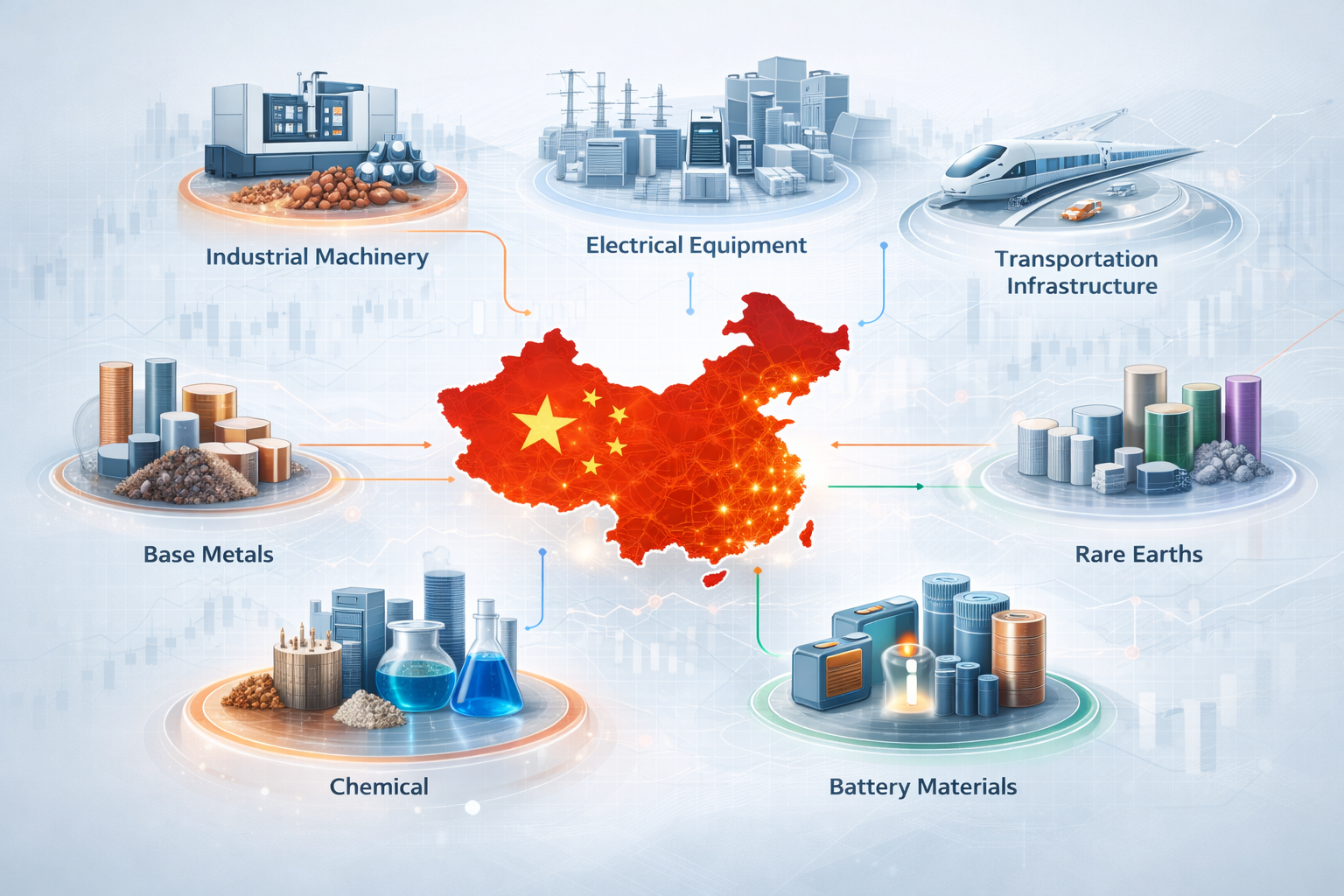
China’s industrial and materials sectors are simultaneously the most policy-sensitive, the most commodity-exposed, and the most structurally transformed parts of the Chinese equity market. They are less discussed than China’s internet giants but far more critical for investors navigating global commodity cycles, green energy infrastructure build-outs, and the geopolitical implications of supply chain restructuring. For foreign investors, these sectors offer genuine alpha opportunities — but require a markedly different analytical toolkit than any other market.
This guide provides a complete institutional framework: definitions, subsector mechanics, the MSCI index architecture, access routes, stock-picking criteria, and a rigorous risk map. It is designed for global investors who need to go beyond screeners and quote pages.
1. Definitions & Sector Map
What Are China Industrial Stocks?
Under the GICS (Global Industry Classification Standard) framework used by MSCI and all major index providers, the Industrials sector covers companies whose primary revenues derive from:
- Manufacturing and distributing capital goods (machinery, aircraft, ships, rail equipment)
- Providing commercial services and transportation
- Constructing and engineering large infrastructure projects
- Supplying electrical components and equipment for industrial use
In China, the Industrials sector is uniquely shaped by the government’s role as both customer and regulator. The single largest client for most Chinese industrial companies is the Chinese state itself — via infrastructure projects, military procurement, and SOE-to-SOE supply chains.
GICS Industrials sub-industries with material China weighting:
- Electrical Components & Equipment (23.8% of MSCI China Industrials)
- Construction Machinery & Heavy Transportation Equipment (15.4%)
- Air Freight & Logistics (12.7%)
- Construction & Engineering (8.5%)
- Marine Transportation (5.9%)
- Rail Transportation and Highways & Railtracks (~3.7% combined)
- Aerospace & Defense (2.8%)
- Industrial Conglomerates (5.9%)
What Are China Materials Stocks?
The GICS Materials sector covers companies engaged in:
- Metals and Mining: base metals (copper, aluminum, nickel), steel value chains, precious metals (gold, silver)
- Chemicals: commodity chemicals (petrochemicals, fertilizers), specialty chemicals, solvents
- Construction Materials: cement, glass, building aggregates, insulation
- Containers & Packaging: paper, cardboard, specialty films
- Battery & Strategic Materials: lithium carbonate, cobalt, graphite anode materials, rare earth elements
China’s materials sector is globally significant beyond its equity weight. China controls ~90% of global rare earth processing, is the world’s largest steel producer (surpassing global #2-10 combined in output), and is the dominant refiner for lithium and cobalt — the battery chemistry inputs critical to the global energy transition.
Why These Sectors Behave Differently in China
Three structural features differentiate China Industrials and Materials from developed market equivalents:
- State-Directed Demand: Government infrastructure spending, Five-Year Plans, and “new infrastructure” programs create demand cycles that have no equivalent in Western markets. A single policy announcement can shift multi-billion RMB orders across multiple companies overnight.
- SOE Dominance: State-Owned Enterprises (SOEs) are the largest players in construction, engineering, rail, marine, and base metals. This provides earnings stability and credit access but constrains profit margins and governance quality relative to private-sector peers.
- Overcapacity Risk: China has structurally built industrial capacity faster than organic demand can absorb it. Steel, cement, aluminum, and solar glass all exhibit periodic overcapacity crises that devastate margins for otherwise well-run companies. This is a structural feature, not a temporary anomaly.
2. “How the Game Works” — Key Drivers
Macro Drivers
Manufacturing PMI is the single most useful leading indicator for both sectors. China’s Manufacturing PMI reached 50.3 points in January 2026, rising from 50.1 in December 2025, representing modest expansion territory. However, ING analysts noted that PMI data hints at soft domestic challenges remaining in early 2026 despite headline expansion.
Credit impulse — the rate of change of new credit as a share of GDP — historically leads Chinese industrial profits by 6–12 months. When credit expands, construction activity accelerates, which drives demand for cement, steel, copper wiring, and heavy machinery. The 2024 stimulus cycle, which included RMB 6 trillion in local government debt support and RMB 500 billion in policy-based financial instruments, began transmitting into industrial order books in late 2024.
Infrastructure spending is the most direct lever for industrial stocks. However, cumulative year-on-year growth in broad infrastructure investment fell sharply from 11.5% in March 2025 to just 1.5% in October 2025, reflecting fiscal constraints at the local government level. New policy instruments announced in September 2025 — targeting digital economy, AI, and urban renewal projects — are expected to support a moderate infrastructure rebound in 2026, though the orientation has shifted toward technology-enabled new infrastructure rather than traditional roads and bridges.
Property cycle spillovers remain the most important negative drag. China’s property sector contraction since 2021 has compressed demand for steel rebar, cement, copper fittings, and construction machinery simultaneously — creating a multi-year headwind for traditional materials companies despite government attempts to stabilize the market.
Policy Drivers
China’s industrial policy is the most consequential factor distinguishing Chinese industrial stocks from global peers. Made in China 2025 (MIC2025) directed over $1.15 trillion of investment into priority sectors including robotics, NEVs, aerospace, and new energy. The outcomes were measurably positive: investments in priority sectors tripled, robotics achieved a 19.8% CAGR, and green technologies grew at 20.2% CAGR. MIC2025 helped China dominate global output in solar panels (47.5% market share) and railway equipment (37.2% share).
The successor policy framework — embedded in the 14th and 15th Five-Year Plans — continues this trajectory but with a shift in emphasis from capacity expansion to quality upgrading, digitalization, and reducing foreign technology dependency. Investors should map their sector exposures to the current Five-Year Plan’s priority industries: AI computing infrastructure, intelligent manufacturing, new energy vehicles, grid modernization, and carbon-neutral industrial processes.
Commodity Drivers (Materials Sector)
The transmission mechanism from commodity prices to earnings is direct but often lagged by 1–2 quarters due to contract structures and inventory cycles:
| Commodity | Primary Impact | Key Listed Players (China) |
|---|---|---|
| Copper | Drives electrical equipment, grid supply chain | Jiangxi Copper (600362), Zijin Mining (601899/2899.HK) |
| Aluminum | Construction, EVs, packaging | China Hongqiao (1378.HK), Chalco (601600/2600.HK) |
| Steel | Construction, shipbuilding | Baoshan Iron & Steel (600019), HBIS Group |
| Lithium | Battery materials, EVs | Tianqi Lithium (002466/9696.HK), Ganfeng Lithium (002460) |
| Rare Earths | EV motors, defense electronics, wind turbines | China Northern Rare Earth (600111), JLMAG (6680.HK) |
| Graphite | Battery anode, specialty industrials | Fangda Carbon (600516), BTR (835185) |
China reduced its annual average output growth target for ten non-ferrous metals from 5% to just 1.5% in 2025, signaling a deliberate shift toward supply discipline and quality over volume. This policy change is positive for long-run pricing in aluminum, copper, and specialty metals.
FX and Funding
For USD-based investors, RMB depreciation directly reduces dollar-denominated returns from A-share and H-share holdings. The RMB is managed within a crawling peg; sudden sharp depreciations typically occur during periods of capital outflow or US dollar strengthening cycles.
Chinese industrial companies are heavily leveraged, with debt often funded at variable rates through state-linked banking channels. When the PBOC tightens, refinancing costs rise and capex programs slow. Conversely, rate cuts (as seen in 2024) directly reduce interest burden and improve free cash flow generation.
3. Subsector Breakdown
Industrials Subsectors
Machinery & Industrial Automation
Business Model: Manufactures CNC machines, robots, precision instruments, and industrial automation components for downstream manufacturers. Revenue mix: equipment sales (one-time) + service and parts (recurring). This sub-sector benefits directly from China’s labor cost escalation and MIC2025 manufacturing upgrade mandates.
Margin Structure: Gross margins typically 25–40% for specialty automation; 15–25% for commodity machinery. Operating leverage is high — volume-sensitive.
Key KPIs: Order backlog (leading indicator), book-to-bill ratio, robotics unit deployment data, R&D as % of revenue.
Main Catalysts: Government subsidies for factory automation, export competitiveness in Southeast Asia and Belt & Road markets, robotics density targets (China’s robot density was 392 per 10,000 workers in 2022, vs. 1,000+ in South Korea — implying long structural runway).
Main Risks: Competition with Japanese (Fanuc, Keyence) and German (Siemens, KUKA) equipment; intellectual property gaps in high-precision niches.
What a Good Company Looks Like: High R&D reinvestment (>8% of sales), diversified end-market exposure (not purely construction or property-linked), strong after-sales service revenue as % of total, and international sales growth.
Reference Names: NARI Technology (600341 A-share) — grid automation; Sany Heavy Industry (600031 A-share) — construction machinery; Sungrow Power Supply (300274) — inverters and energy storage.
Transportation & Logistics
Business Model: Air freight, express delivery, rail freight, ocean container shipping. China dominates global shipping via COSCO and has built the world’s largest express delivery network domestically.
Margin Structure: Express delivery: EBIT margins typically 5–12% and improving with automation. Ocean shipping: highly cyclical, tied to container rates.
Key KPIs: Package volume growth, cost-per-parcel, freight rate benchmarks (Baltic Dry Index for marine), network utilization.
Main Catalysts: E-commerce volume growth, cross-border trade expansion, Belt & Road logistics corridor development.
Main Risks: Rate cycle collapse in shipping; price wars in express delivery among SF Holdings, ZTO, and JD Logistics; geopolitical restrictions on port access.
Reference Names: ZTO Express (ZTO listed in US; H-share 2057.HK) — the market leader in express by volume with 25%+ market share; COSCO Shipping Holdings (601919/1919.HK); SF Holding (002352/6936.HK) — premium express logistics.
Electrical Equipment & Grid Supply Chain
Business Model: Manufactures transformers, power converters, inverters, high-voltage cables, and smart grid components. China’s grid upgrade and renewable integration programs make this the highest-structural-growth Industrials subsector.
Margin Structure: Gross margins 20–35%. Premium for proprietary inverter technology and grid software.
Key KPIs: Grid capex announcements from State Grid Corporation of China (SGCC), renewable energy capacity additions, HVDC (high-voltage direct current) project pipeline.
Main Catalysts: China’s 14th Five-Year Plan targeted 1,200 GW of wind and solar by 2030; grid investment must scale proportionally. The 15th Five-Year Plan emphasizes “new-type energy storage” and AI-integrated grid management.
Main Risks: Technology competition from Western ABB and Siemens subsidiaries; government pricing pressure on grid components.
Reference Names: NARI Technology (600341) — grid protection/automation; Sungrow Power (300274) — world’s largest string inverter maker; Contemporary Amperex Technology (CATL, 300750) — while classified under Industrials by MSCI in China index.
Construction & Engineering
Business Model: EPC (Engineering, Procurement, Construction) of infrastructure: railways, highways, bridges, ports, nuclear plants. Dominated by large SOEs with government mandates and preferential financing.
Margin Structure: Net margins extremely thin: 1.5–3%. High revenue but capital-intensive balance sheets with significant project receivables.
Key KPIs: New contract wins (vs. prior year), project backlog / trailing revenue ratio, accounts receivable days, debt maturity schedule.
Main Catalysts: National infrastructure packages, Belt & Road international projects, urban renewal initiatives.
Main Risks: Property market weakness constraining municipal finance (local government revenue shortfalls reduce new project awards); project receivable collectability; working capital strain.
Reference Names: China State Construction Engineering (601668 A-share); China Railway Group (601390); CITIC Limited (0267.HK) — diversified construction conglomerate.
Materials Subsectors
Base Metals: Copper and Aluminum
Copper is the most structurally important metal for China’s energy transition. It is non-substitutable in grid cables, EV motors, and charging infrastructure. Chinese copper smelters process more copper than any other country — but the key distinction (explained in the Jiangxi Copper guide) is between integrated miners and pure smelters.
For equity investors: Zijin Mining (601899/2899.HK) is the premium growth play in China copper/gold — it has materially higher mine ownership and international diversification than Jiangxi Copper. Jiangxi Copper (600362/358.HK) is the volume/smelting play with high yield but lower leverage to price upside.
Aluminum dynamics differ: China Hongqiao (1378.HK) and Chalco (002600/2600.HK) are the primary listed vehicles. Aluminum margins are driven by power costs (electricity is ~35% of aluminum smelting cost), bauxite availability, and carbon regulation. Companies with captive renewable power — increasingly common in Yunnan and Inner Mongolia — have sustainable cost advantages.
Steel Value Chain
Business Model: Iron ore + coking coal → pig iron → steel → downstream (rebar, plate, coil). China produces >1 billion tonnes annually, >50% of global output.
Margin Structure: Ultra-thin: 1–3% net margins in normal cycles; can turn negative during iron ore price spikes or property demand collapses.
Key KPIs: China steel spread (HRC price vs. coking coal + iron ore cost); capacity utilization rates; property construction starts (most direct demand signal).
Main Risks: The property sector contraction since 2021 has been the primary drag on steel margins. Recovery requires property market stabilization, not just macro stimulus.
Reference Names: Baoshan Iron & Steel / Baosteel (600019) — highest quality, auto-grade steel focus; HBIS Group — largest by volume.
Chemicals: Commodity vs. Specialty
Commodity chemicals (fertilizers, PVC, caustic soda) trade near marginal cost in China due to massive capacity installed through state investment cycles. Investing in commodity chemicals requires a specific catalyst (capacity closure mandate or demand surge) rather than a structural thesis.
Specialty chemicals — high-value compounds for semiconductors, displays, battery separators, adhesives — represent the highest-quality sub-segment. Companies like Ganfeng Lithium (002460) straddle mining and chemicals, producing lithium carbonate and lithium hydroxide for battery cells.
Key KPIs: Spreads (product price minus feedstock), capacity utilization, R&D pipeline, customer concentration.
Battery Materials: Lithium & Graphite
This subsector connects directly to the global EV megatrend and represents one of the highest-volatility, highest-potential-reward segments in China Materials.
Lithium prices collapsed from $80,000/tonne in late 2022 to below $10,000/tonne by 2024, destroying margins across the entire value chain. This cycle illustrates the fundamental risk of investing in early-stage, high-growth materials: oversupply can be catastrophic even when demand remains structurally robust.
Recovery indicators to watch: Inventory drawdowns in lithium carbonate, plant utilization at Chinese battery makers (CATL being primary bellwether), and global EV penetration rate trajectory.
Reference Names: Tianqi Lithium (002466/9696.HK) and Ganfeng Lithium (002460/1772.HK) — the two largest listed Chinese lithium producers.
Rare Earths & Strategic Materials
China controls over 90% of global rare earth processing and nearly all upstream refining capacity for elements critical to EV motors (neodymium, praseodymium), wind turbine generators, defense electronics, and semiconductor manufacturing.
In October 2025, China dramatically expanded export controls, adding five new elements (samarium, terbium, thulium, europium, and ytterbium) and imposing extraterritorial provisions requiring Chinese export licenses for products made with Chinese rare earth materials — even by foreign manufacturers. In November 2025, following a Trump-Xi summit, China temporarily suspended these controls for one year (November 2025–November 2026), providing a tactical reprieve for global manufacturers while preserving long-term strategic leverage.
For investors, this regulatory toggle illustrates the critical distinction between fundamental value and geopolitical risk premium. Rare earth stocks can be fundamentally well-positioned but experience sharp de-ratings when export control risk is priced in, and equally sharp re-ratings when controls are temporarily eased.
Reference Names: China Northern Rare Earth Group (600111 A-share) — the largest rare earth producer; JLMAG Rare-Earth (6680.HK) — specialty magnets; Shenghe Resources (600392) — integrated rare earth and titanium.
Construction Materials: Cement & Glass
Business Model: Capital-intensive fixed-cost businesses selling commoditized products to construction and real estate. Revenue follows construction activity with high operating leverage.
Current Cycle Position: Both cement and glass face multi-year overcapacity linked to property market weakness. Chinese cement companies like CNBM (3323.HK) and Anhui Conch Cement (600585/0914.HK) have seen margin compression that cannot fully recover until property demand stabilizes.
Contrarian Angle: These companies trade at historically extreme discounts to book value. If China’s property market achieves a durable stabilization (the base case for T. Rowe Price’s 2026 China outlook ), construction materials represent a high-beta recovery play. The key catalyst is housing starts data — leading by ~6 months to cement volume.
4. Where to Buy: Access Routes for Foreign Investors
Foreign investors have four primary routes to access China Industrials and Materials stocks. The correct route depends on target name availability, broker infrastructure, and structural risk tolerance.
| Access Route | What’s Available | Key Requirement | Best For |
|---|---|---|---|
| A-Shares (Stock Connect) | ~2,600 Shanghai/Shenzhen stocks | HK broker with Northbound Connect | Institutional targeting specific A-share names |
| H-Shares / HK Listings | Major SOEs, large-caps (COSCO, CITIC, Chalco) | International broker with HK access | Global institutional allocators |
| US ADRs | Limited Industrials/Materials coverage | Standard US brokerage | Only for companies with US listings (ZTO, Kanzhun) |
| ETFs (US-listed or regional) | Broad or thematic China sector | Standard brokerage | Most efficient for sector exposure |
Stock Connect is the critical mechanism for A-share access. Launched in 2014 (Shanghai Connect) and expanded in 2016 (Shenzhen Connect), it allows foreign investors to buy eligible A-shares through their Hong Kong brokers without a QFII license. As of late 2024, the MSCI China A Industrials Index tracks 61 A-share Industrials stocks accessible via Stock Connect.
Decision Framework:
- “I want broad China sector exposure with minimal complexity” → Broad China ETF (MCHI) or a China sector ETF
- “I want targeted Industrials/Materials exposure” → Thematic ETF (Global X China Materials, or A-share sector ETF)
- “I want specific stock exposure to a named A-share company” → Stock Connect via international broker
- “I want HK large-cap SOE exposure with direct ownership” → H-shares via HK broker (COSCO, Chalco, Anhui Conch, Zijin Mining H-shares)
5. Indices & ETFs
Index Architecture
MSCI China Industrials Index (benchmark for offshore-accessible Industrials) contains 79 constituents with a market cap of CNY 923 billion. Key characteristics as of September 30, 2025:
- P/E: 12.48x (vs. MSCI China overall: 15.80x)
- Forward P/E: 11.35x
- P/BV: 1.27x
- Dividend Yield: 3.04%
- 2024 annual performance: +20.56% (outperformed MSCI China’s +19.66%)
MSCI China A Industrials Index (A-shares only, Stock Connect accessible) contains 61 constituents with:
- P/E: 15.27x
- P/BV: 1.59x
- Dividend Yield: 2.36%
- The index has delivered stronger long-run returns: +196.73% cumulative vs. +144.28% for MSCI China A overall since 2010
Top constituent by weight in both indices is Contemporary Amperex Technology (CATL), reflecting the electrical equipment reclassification. CATL’s dominance distorts both indices significantly: it represents 19% of the A-share Industrials index.
ETF & Investment Vehicle Table
| Vehicle | Exposure | Structure | Pros | Cons | Best For |
|---|---|---|---|---|---|
| iShares MSCI China ETF (MCHI) | Broad China incl. Industrials (~5%) + Materials (~6%) | US-listed ETF | Liquid, low cost (0.59%), broad diversification | Low sector weight; dominated by tech/consumer | Core China allocation |
| Global X China Materials ETF | Dedicated China Materials (~30 stocks) | ETF (metals ~50%, chemicals ~30%, construction ~20%) | Targeted exposure; foreign-accessible stocks only | Concentrated; correlated to commodity cycle | Commodity cycle plays |
| China Industrials/Sector ETF (A-share type) | A-share Industrials via domestic or Stock Connect-based vehicle | Varies by domicile | Direct A-share access | Requires international broker with HK/CN access; higher fees | Institutional specialists |
| Direct H-shares | Blue-chip SOE Industrials and Materials | Individual stocks | No management fee, direct ownership, dividends | Research-intensive, currency risk | Active stock-pickers |
What investors should verify before buying any China sector ETF:
- SOE weight: Higher SOE weight = more policy sensitivity, lower governance, typically lower ROE but more stable earnings
- Holdings concentration: The MSCI China A Industrials top 10 represent 48.7% of the index — dominated by CATL
- Liquidity: Check average daily volume vs. fund AUM; thin China sector ETFs can have wide bid-ask spreads
- Tracking difference: The gap between ETF NAV return and index return, reflecting rebalancing and FX costs
- A-share vs. offshore split: Funds with more A-share content have higher mainland market exposure; funds with HK-listed stocks have lower currency and repatriation risk
6. Screening & Stock-Picking Framework
Picking individual China Industrials and Materials stocks requires a structured analytical approach that incorporates both fundamental quality screening and policy cycle positioning.
Core Analytical Framework
1. Pricing Power and Contract Structure
Does the company sell in competitive spot markets or through long-term contracts? Construction SOEs bid on government contracts at low margins with limited pricing flexibility. Industrial automation companies with proprietary software often lock in multi-year service agreements. Pricing power separates 3% net-margin companies from 25% net-margin companies within the same GICS category.
2. End-Market Demand Mix
Companies exposed to new economy demand (EV supply chains, grid upgrades, AI infrastructure) structurally outperform those exposed to old economy demand (property construction, traditional steel applications). Investors should explicitly classify the revenue split: what % comes from construction/property, what % from the green economy, what % from export.
3. Balance Sheet Resilience
China Industrials companies are capital-intensive borrowers. Key checks: debt-to-equity ratio (<150% is preferable), short-term debt as % of total debt (refinancing risk), and interest coverage ratio (EBIT / interest expense > 3x is minimum threshold). SOEs typically have superior balance sheets due to state banking access, but private companies carry higher operating risk during credit tightening cycles.
4. Cash Conversion and Capex Discipline
Cash conversion cycle is particularly important for construction and engineering companies, which routinely carry large project receivables that can mask deteriorating collections. Check: operating cash flow vs. net income (should be approximately equal or higher for quality companies); capex as % of sales (>15% is capital-intensive); free cash flow yield.
5. Governance: SOE vs. Private
Private industrial companies (Sany Heavy, ZTO Express, SF Holding) typically offer better capital allocation, faster strategic decision-making, and greater management incentive alignment. SOEs (COSCO, China State Construction, CRRC) offer greater earnings stability, better financing access, and dividend predictability — but return on equity is structurally lower.
6. Cycle Sensitivity vs. Structural Growth
Classify each holding on a spectrum from pure cyclical (steel, cement) to structural growth (grid automation, express logistics). A balanced China Industrials/Materials portfolio should hold both: cyclicals for the upswing, structural growers for long-run compounding.
The 10 Questions Before Buying
- What % of this company’s revenue comes from the property/construction sector?
- Has the company grown EBIT margins over the last 3 years, or has margin expansion been offset by cost inflation?
- What is the free cash flow yield, and does operating cash flow reconcile with reported net income?
- How concentrated is the customer base — is any single customer (including the Chinese government) >20% of revenue?
- Is this company an SOE or private? What are the governance implications for capital allocation and minority shareholder returns?
- What is the current debt maturity profile, and could a credit tightening cycle force dilutive equity raises?
- Does the company benefit from Made in China 2025 / 15th Five-Year Plan priority sectors?
- What is the commodity price sensitivity — and what is the earnings impact of a 20% commodity price decline?
- Is the stock available via Stock Connect / H-share, and is my access route appropriate for my compliance requirements?
- Has this company been subject to regulatory investigation, environmental enforcement action, or anti-monopoly scrutiny?
7. Risks
Policy and Regulatory Surprises
The Chinese government acts decisively and with minimal regulatory pre-warning when it determines that an industry’s structure is misaligned with national priorities. The 2020-2021 crackdown on private tutoring and internet platforms demonstrated this capacity. In the industrial sector, environmental enforcement actions (sudden plant closures to meet pollution targets) and anti-monopoly investigations (targeting pricing cartel behavior in cement and steel) can disrupt earnings materially within a single quarter.
Geopolitics, Tariffs, and Sanctions Spillovers
US export controls on semiconductor manufacturing equipment directly affect Chinese industrial automation companies seeking to buy foreign CNC equipment and precision tooling. The “China Plus One” supply chain diversification trend reduces international order flow for Chinese industrial exporters as multinationals shift assembly to Vietnam, India, and Mexico. The rare earth export control episodes of 2025 illustrated that China can weaponize its materials supply chain position — but this cuts both ways, incentivizing Western efforts to develop alternative supply chains.
Accounting and Transparency Variance
Chinese GAAP (CAS) differs from IFRS and US GAAP in revenue recognition timing, lease accounting, and the treatment of government subsidies (which are a material income line for many SOEs). Project receivables at construction companies can remain on balance sheets for years without writedown. Investors using Western financial databases should verify that adjustments for government subsidies and non-recurring items have been applied before comparing margins to non-Chinese peers.
Commodity Price Collapse
For Materials stocks, a 20-30% decline in copper, lithium, or aluminum prices can turn a profitable company unprofitable within two quarters. The lithium collapse of 2022-2024 is the most recent case study: prices fell 85% from peak to trough, eliminating years of earnings in less than 18 months. Investors should stress-test any materials holding against a severe commodity downside scenario before sizing positions.
Overcapacity and Margin Compression
China systematically builds industrial capacity above near-term demand, driven by provincial government growth mandates and state bank lending incentives. Cement, glass, PVC, steel, and polysilicon have all experienced capacity-driven margin collapses. When a new product category becomes a national policy priority (as with solar glass, lithium, or graphite), investors should anticipate aggressive capacity expansion by state-backed competitors within 3–5 years.
Liquidity and Market Structure Risk
A-shares are retail-dominated (approximately 80% retail by transaction volume), creating sharp momentum cycles in both directions. Stocks can move 20–30% in days on policy announcements or social media sentiment shifts, with no fundamental news. For institutional investors managing large positions, exit liquidity in A-share small-caps can be severely constrained during market stress events.
Currency Risk for USD-Based Investors
RMB-denominated A-share returns are subject to USD/CNY exchange rate movements. The RMB has depreciated approximately 10–15% against the USD during periods of dollar strength (2018, 2022). While HKD-denominated H-shares remove direct currency risk (via the HKD peg), RMB earnings still translate at unfavorable rates during depreciation periods.
Risk Summary Table
| Risk Category | Impact Level | Mitigation |
|---|---|---|
| Policy/Regulatory Surprise | Very High | Diversify across sub-industries; avoid single-sector concentration |
| Geopolitics / Tariffs | High | Prefer domestically focused revenue; avoid high export-dependent names |
| Commodity Price Collapse | High for Materials | Stress-test earnings; include hedged or integrated producers |
| Overcapacity / Margin Compression | High | Avoid pure capacity plays; focus on pricing power |
| Accounting / Transparency | Medium-High | Use cash flow statements, not just P&L; verify receivables quality |
| Liquidity (A-shares) | Medium | Use ETFs for small-cap exposure; stick to Stock Connect eligible stocks |
| FX (USD-based investors) | Medium | Use HK-listed H-shares where available; hedge if size justifies |
8. FAQ
What are the top 5 industries of China from an investor framework perspective?
In equity market terms, China’s five most investor-significant sectors are: (1) Internet/Technology platforms (Tencent, Alibaba — consumer discretionary + communication services under GICS); (2) Financials (state-owned banks and insurers); (3) Industrials (electrical equipment, logistics, construction machinery — driven by Five-Year Plan infrastructure); (4) Materials (copper, aluminum, rare earths, battery inputs — driven by energy transition); and (5) Consumer Discretionary (NEVs, retail, food delivery). For industrial and commodity-cycle investors, sectors 3 and 4 are the primary focus.
How do foreign investors buy China sector stocks?
Via four routes: (1) US-listed ADRs (available only for companies with US listings — limited in Industrials/Materials); (2) Hong Kong H-shares through international brokers; (3) A-shares via Northbound Stock Connect through a Hong Kong broker; and (4) US-listed ETFs (MCHI for broad exposure; Global X China Materials ETF for materials-specific).
Is China’s industrial sector driven by policy?
More so than any other major market. The Five-Year Plan system creates direct revenue flows to favored sectors; environmental enforcement creates sudden supply disruptions; procurement rules favor domestic manufacturers. Investors who ignore policy signals and focus purely on financial screens will systematically misread the sector.
What makes a China materials stock risky?
Four compounding risks: (1) commodity price volatility with no producer pricing power; (2) government-mandated capacity expansion that destroys incumbent margins; (3) environmental enforcement that closes facilities without warning; and (4) geopolitical risk — as demonstrated by China’s export control actions on rare earths, which can simultaneously benefit domestic rare earth companies while decimating downstream users.
Best way to think about “best” material stocks?
Rather than naming the best stock, the analytical framework recommends evaluating: lowest-cost producer in the relevant commodity (sustainable margins through the cycle); highest integration level (miners who also process have more margin capture); least property-sector revenue dependency; and strongest governance (private > SOE for capital allocation quality). Applying this framework, copper/gold miners with international asset diversification, specialty chemical companies with pricing power, and rare earth processors with long-term supply contracts score highest on quality-adjusted cycle resilience.
9. Conclusion
China Industrials and Materials stocks are among the most analytically complex but strategically important components of any global emerging market portfolio. They are best suited for investors who:
- Have a medium-to-long-term commodity and infrastructure cycle outlook
- Can tolerate policy binary risk (sudden regulatory or supply disruption) in exchange for deep value and structural growth exposure
- Are willing to engage with the structural China discount on H-shares and A-shares relative to Western equivalents
Preferred exposure routes by investor type:
- Core EM allocators: Use MCHI (broad China) — Industrials and Materials are automatically represented at ~11% combined
- Sector specialists (materials cycle): Global X China Materials ETF for managed exposure; H-shares of Zijin Mining, Tianqi Lithium, Anhui Conch for direct company exposure
- Sector specialists (industrial),: MSCI China A Industrials index-tracking vehicle (via Stock Connect eligible fund) or direct H-share/A-share positions in Sany Heavy, NARI Technology, ZTO Express
- Thematic energy transition investors: Focus on CATL (A-share / H-share in preparation), Sungrow Power, Zijin Mining, and rare earth processing chains
Key watch indicators for 2026:
- China Manufacturing PMI trend — needs sustained >51 for meaningful industrial earnings recovery
- Property market housing starts — the primary demand signal for steel, cement, and construction machinery
- Rare earth export control policy evolution — the November 2025–November 2026 temporary suspension expires and Beijing’s next move will signal long-term strategic posture
- Infrastructure capex disbursements from RMB 500B policy instruments announced in September 2025
- PBOC credit conditions — a loosening credit impulse typically precedes industrial earnings recovery by 6–12 months
China industrial and materials stocks are not for passive investors seeking simplicity. They are for investors who understand that in China, macroeconomic policy, commodity supply chains, and geopolitical strategy are not external variables — they are the business model.
This guide does not constitute financial advice. All investment decisions should be made with reference to personal financial circumstances, risk tolerance, and professional advice where appropriate.