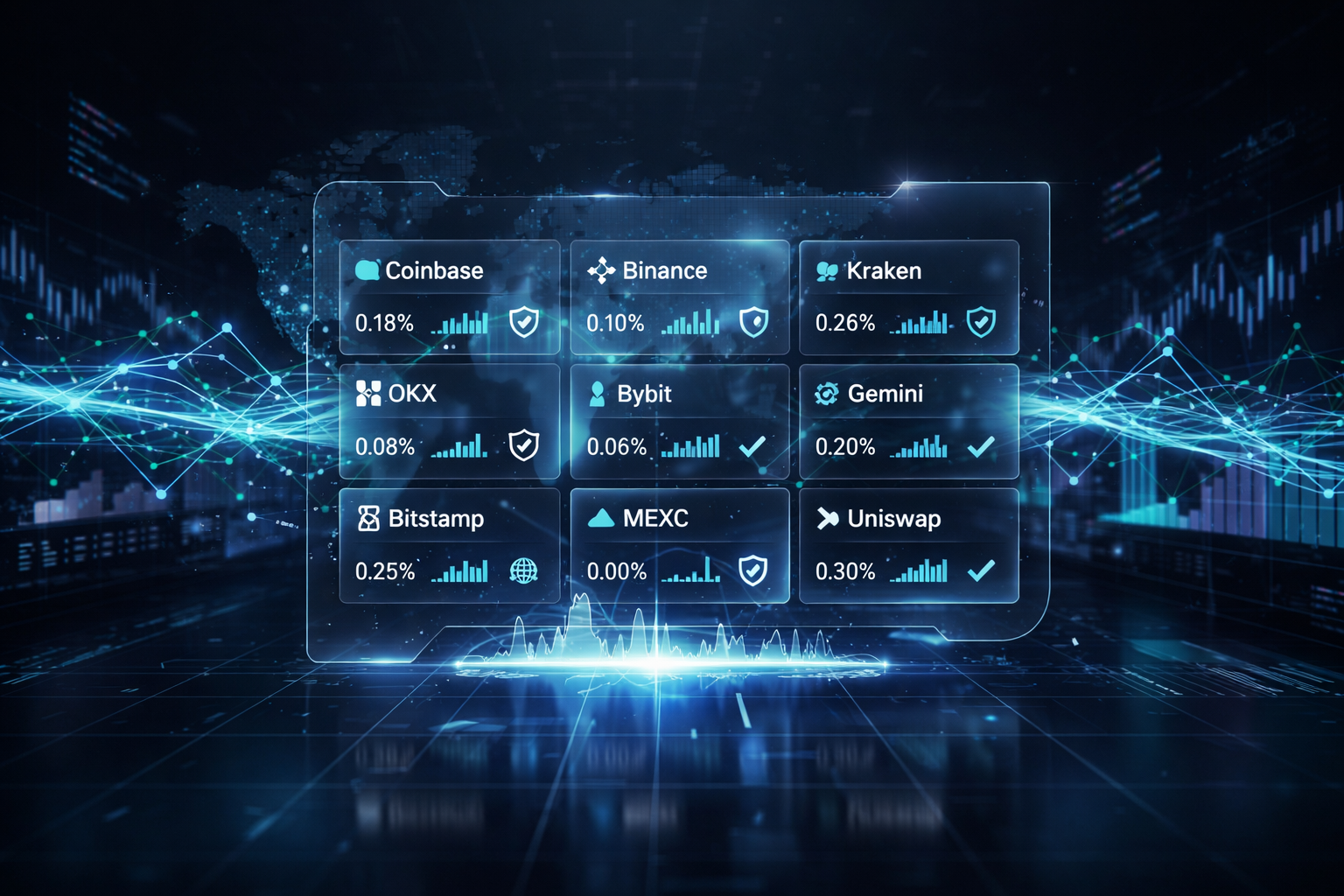
The cryptocurrency exchange landscape in 2026 operates under fundamentally different conditions than previous years. With the European Union’s Markets in Crypto-Assets (MiCA) regulation in full enforcement since January 2026 and evolving U.S. regulatory frameworks clarifying the roles of the SEC and CFTC, selecting a crypto exchange now requires evaluation across security, regulatory compliance, custody models, fee structures, and liquidity depth. This guide provides institutional-grade analysis of centralized exchanges (CEXs), decentralized exchanges (DEXs), and hybrid models to inform platform selection based on verifiable metrics rather than marketing claims.
Who This Guide Is For
This analysis serves professional traders requiring deep liquidity and advanced derivatives tools, institutional investors prioritizing regulatory compliance and custody standards, retail users seeking secure fiat on-ramps with transparent fee structures, DeFi participants evaluating non-custodial alternatives, and compliance officers assessing jurisdictional risk exposure.
Key Takeaways
MiCA compliance now mandatory for EU operations, requiring CASP licensing and 100% stablecoin reserve backing with monthly audits, affecting over 3,000 EU-based crypto firms. Security models diverge sharply: CEXs face centralized custody risk and single-point-of-failure vulnerability, while DEXs expose users to smart contract exploits, with approximately $2.2 billion stolen across both models in 2024. Fee structures in 2026 range from 0% maker/0.05% taker on MEXC to over 1% plus spread on Coinbase, with VIP tiers and native token holdings reducing costs significantly. Liquidity depth varies dramatically: Binance dominates spot markets while MEXC leads futures liquidity across 17 of 20 analyzed trading pairs.
Top Exchanges by Category
| Category | Exchange | Key Differentiator | Base Fees | Regulation Status |
|---|---|---|---|---|
| Best Overall | Binance | Deepest spot liquidity, 350+ assets | 0.10% maker/taker | MiCA compliant (€500M invested) |
| Best for Beginners | Coinbase | Intuitive UX, SEC-audited financials | 1.0%+ plus spread | US SEC-regulated, public company |
| Best Low Fees | MEXC | 0% maker fees, 0.05% taker | 0.00%/0.05% | International, MX token discounts |
| Best Derivatives | Bybit | 125x leverage, $17.58B open interest | 0.02%/0.055% | VARA (Dubai), CySEC (Cyprus) |
| Best Altcoins | KuCoin | 700+ assets, emerging tokens | 0.10%/0.10% | International, KCS discounts |
| Best DEX | Uniswap | $1.2B+ daily volume, non-custodial | 0.05-1.00% protocol fee | Decentralized, no KYC |
| Most Secure | Kraken | Merkle tree PoR since pre-FTX, verified reserves | 0.16%/0.26% | US FinCEN, EU MiCA compliant |
| Best US-Regulated | Gemini | Fiduciary custody, NYDFS BitLicense | 0.35%/0.40% | NYDFS, SOC 2 Type 2 certified |
What Is a Crypto Exchange (2026 Context)
Definition Evolution
A cryptocurrency exchange functions as a digital marketplace facilitating the buying, selling, and trading of crypto assets, operating through order book matching, liquidity pools, or automated market makers (AMMs) depending on architectural model. In 2026, exchanges are no longer monolithic entities but differentiated platforms requiring classification across custody model (custodial vs. non-custodial), regulatory framework (licensed vs. offshore), and operational structure (centralized vs. decentralized vs. hybrid).
CEX vs DEX vs Hybrid
Centralized exchanges (CEXs) operate as intermediaries holding user funds in custodial wallets, processing transactions off-chain with instant settlement but introducing counterparty risk and requiring KYC compliance. Decentralized exchanges (DEXs) enable peer-to-peer trading directly from user wallets via smart contracts, eliminating custody risk but exposing users to code vulnerabilities, oracle manipulation, and maximum extractable value (MEV) attacks. Hybrid models emerging in 2026 attempt to combine CEX liquidity and fiat rails with DEX custody principles through layer-2 settlement and non-custodial order books.
Exchange vs Broker vs Aggregator
Exchanges provide direct access to order books where users trade with other participants at market-determined prices, while brokers act as principals executing trades at quoted spreads without exposing underlying order flow. Aggregators like Exolix route orders across multiple exchanges and DEXs to optimize execution price, charging no direct trading fees but capturing value through rate spreads. Understanding these distinctions matters for fee analysis: exchange maker-taker models incentivize liquidity provision, broker spreads obscure true transaction costs, and aggregator rates vary based on routing efficiency.
Role in Crypto Ecosystem
Exchanges serve as primary price discovery mechanisms, fiat on/off-ramps for converting traditional currency to digital assets, liquidity aggregation points enabling efficient trade execution, and custody providers for users unwilling or unable to self-custody. In 2026, regulated exchanges additionally function as compliance gatekeepers implementing AML/KYC standards, tax reporting interfaces, and consumer protection mechanisms mandated by MiCA and evolving national frameworks.
Types of Crypto Exchanges
Centralized Exchanges
CEXs dominate trading volume through superior user experience, instant fiat conversion, deep order books, and customer support infrastructure. These platforms control private keys, maintain off-chain transaction ledgers, and assume responsibility for security, regulatory compliance, and insolvency risk. Major CEXs in 2026 include Binance (largest by spot volume), Coinbase (leading US-regulated), Kraken (strongest transparency), OKX (deep derivatives markets), and Bybit (highest leverage offerings).
Decentralized Exchanges
DEXs execute trades through smart contracts on blockchain networks, with users retaining private key control and no KYC requirements. Uniswap pioneered the AMM model with liquidity pools replacing order books, now processing $1.2B+ daily volume across Ethereum and layer-2 networks. DEX advantages include censorship resistance, permissionless access, and elimination of custodial risk, while disadvantages encompass smart contract exploit exposure, limited fiat integration, and higher transaction costs during network congestion.
Derivatives Exchanges
Specialized platforms offering perpetual futures, options, and leveraged products generate higher trading volume than spot markets in 2026. Bybit leads with $15.63B daily perpetual volume and $17.58B open interest offering 125x leverage, while OKX processes $21.47B daily perpetual volume with tighter fee structures for VIP tiers. MEXC demonstrates highest liquidity depth across 17 of 20 futures trading pairs analyzed, with Bitget following at 74 points and Binance ranking third.
Brokerage Platforms
Crypto brokers like Robinhood and PayPal simplify access through spread-based pricing without exposing order books, appealing to new entrants prioritizing simplicity over optimization. These platforms typically charge 0.5-2% spreads plus fixed fees, significantly higher than direct exchange access but bundled with familiar interfaces and regulatory protections.
Aggregators
Non-custodial swap services aggregate liquidity across CEXs and DEXs, routing orders to optimize execution price without holding user funds. Platforms like Exolix operate zero-fee models, capturing value through rate spreads while providing cross-exchange arbitrage and reduced slippage for users.
On-Ramp/Off-Ramp Providers
Specialized fiat gateways like MoonPay, Ramp, and Transak integrate with wallets and dApps to enable direct crypto purchases via credit card, bank transfer, or local payment methods. These services charge 2-5% fees but remove exchange account requirements, serving occasional buyers and DeFi users needing rapid fiat conversion.
Comparison of Exchange Types
| Type | Custody Model | KYC Required | Liquidity | Fiat Support | Best For | Risk Profile |
|---|---|---|---|---|---|---|
| Centralized Exchange | Custodial | Yes | Deep | Full | Active traders, fiat conversion | Insolvency, regulatory freeze |
| Decentralized Exchange | Non-custodial | No | Variable | Limited | Privacy, DeFi, self-custody | Smart contract exploits, MEV |
| Derivatives Exchange | Custodial | Yes | Deep (futures) | Full | Leverage trading, hedging | Liquidation, counterparty risk |
| Brokerage Platform | Custodial | Yes | Pooled | Full | Beginners, simple buys | High spreads, limited assets |
| Aggregator | Non-custodial | No | Aggregated | Varies | Optimal pricing, swaps | Rate spread opacity |
| Fiat On-Ramp | Non-custodial | Yes (light) | Single-sided | Full | Quick purchases, wallet funding | High fees, limited amounts |
How Crypto Exchanges Work
Order Book Mechanics
Centralized exchanges maintain off-chain order books recording limit orders at specific price levels, with matching engines pairing buy and sell orders in microseconds. Market makers submit continuous bid and ask quotes creating depth, while market takers execute against existing orders, generating the maker-taker fee structure that incentivizes liquidity provision. Order book depth at 1% and 2% price deviation indicates execution quality: Binance maintains superior depth across major pairs, while smaller exchanges experience significant slippage on mid-cap assets.
Liquidity Providers
On DEXs utilizing AMM models, liquidity providers deposit token pairs into smart contract pools earning trading fees proportional to their share. The constant product formula (x * y = k) automatically adjusts prices based on pool ratios, with liquidity providers bearing impermanent loss risk when token prices diverge from deposit ratios. Concentrated liquidity mechanisms pioneered by Uniswap V3 allow capital efficiency improvements by focusing liquidity within specific price ranges.
Matching Engines
High-frequency trading requires matching engines processing 100,000+ orders per second with sub-millisecond latency. Binance’s matching engine handles 1.4 million orders per second, while OKX and Bybit operate comparable infrastructure supporting algorithmic trading and institutional flow. DEXs lack centralized matching engines, instead processing transactions sequentially on-chain with confirmation times ranging from 12 seconds (Ethereum) to under 1 second (Solana-based DEXs).
Custody Models
CEX custody typically segregates 95%+ of user funds in cold storage (offline wallets) with multi-signature requirements, maintaining 5-10% in hot wallets for withdrawal processing. Kraken implements Merkle tree proof of reserves allowing individual users to verify balance inclusion, while Coinbase relies on SEC-audited financial statements and key signing ceremonies with Deloitte. Insurance coverage varies significantly: 72% of exchanges now offer cyber insurance, 41% maintain custody insurance for cold storage, but hot wallet coverage typically caps at 25-50% of value.
Settlement
CEX transactions settle instantly in internal ledgers, with on-chain settlement occurring only during deposits and withdrawals. DEX transactions settle on-chain within one block confirmation, providing cryptographic finality but requiring gas fees and network confirmation times. Layer-2 solutions like Arbitrum and Optimism reduce DEX settlement costs by 90%+ while maintaining security guarantees of underlying layer-1 chains.
Fee Structures
Exchanges monetize through maker-taker fees (0-0.26%), withdrawal fees (fixed or percentage-based), spread markups on market orders, funding rates on perpetual futures (typically 0.01% every 8 hours), and listing fees charged to token projects. MEXC operates the lowest fee structure at 0% maker/0.05% taker with MX token holdings providing additional 50% discounts, while Coinbase charges highest retail fees exceeding 1% plus undisclosed spreads.
How to Choose the Best Crypto Exchange
Decision Framework
Platform selection requires multi-dimensional evaluation across security architecture (custody model, insurance, proof of reserves), regulatory compliance (licensing jurisdiction, KYC requirements, legal recourse), economic efficiency (maker-taker fees, withdrawal costs, slippage), liquidity depth (order book density, 24h volume, asset coverage), operational capability (API access, advanced order types, mobile functionality), and jurisdictional alignment (geographic restrictions, fiat payment methods, tax reporting).
Security Evaluation
Assess custody through proof of reserves transparency (Kraken’s Merkle tree verification superior to attestation-only approaches), insurance coverage specifics (cold storage vs hot wallet limits), and historical incident response (Bybit’s 2025 security event and remediation approach versus exchanges lacking disclosure). Evaluate technological controls including multi-signature requirements, withdrawal allowlisting, hardware security modules, and bug bounty programs demonstrating proactive security posture.
Regulatory Considerations
MiCA compliance now mandatory for EU users, requiring CASP licensing with enforcement by June 30, 2026, and introducing consumer protections but limiting access to non-compliant exchanges. US users require FinCEN registration at minimum, with SEC and CFTC oversight depending on asset classification as security versus commodity. Offshore exchanges like Bybit and OKX serve international users but lack regulatory recourse and face potential jurisdictional bans.
Fee Optimization
Calculate true cost including maker-taker fees, spread (difference between market order execution and mid-price), withdrawal fees (fixed satoshi amounts or percentage-based), and funding rates for leveraged positions. VIP tier qualification through 30-day volume or token holdings reduces fees substantially: OKX maker fees become negative (rebates) at top tiers, while Bybit eliminates maker fees for Supreme VIPs. For infrequent traders, withdrawal fees dominate cost analysis, with Bitcoin withdrawals ranging from 0.0002 BTC ($15) to 0.0005 BTC ($37) depending on exchange.
Liquidity Assessment
Analyze order book depth at 1% and 2% deviation from mid-price across relevant trading pairs. Binance maintains deepest spot liquidity for BTC/USDT with $50M+ within 1% of mid-price, while MEXC leads perpetual futures depth across SOL, ETH, and emerging altcoins. Low liquidity creates slippage risk: $100,000 market orders on tier-2 exchanges can move prices 0.5-2% versus <0.1% on Binance for major pairs.
Asset Coverage
Binance lists 350+ assets, OKX supports 311 spot markets, Bybit offers 1,800+ assets including tokenized stocks and commodities, while Kraken focuses on 200+ thoroughly vetted assets. Altcoin traders require broad coverage, but listings of unvetted tokens introduce rug pull risk and poor liquidity. DEXs like Uniswap enable permissionless listing of 10,000+ tokens but require due diligence to avoid scam contracts.
User Experience
Evaluate interface complexity, mobile app functionality, customer support responsiveness, educational resources, and API documentation quality. Coinbase optimizes for beginners with guided onboarding and limited advanced features, while Bybit and OKX target active traders with customizable interfaces, TradingView integration, and extensive order types.
Fiat Integration
Assess supported currencies (USD, EUR, GBP vs. limited fiat pairs), payment methods (bank transfer, credit card, local options), deposit and withdrawal times, and fiat-specific fees. Coinbase and Kraken excel in fiat integration with ACH, wire, and card support, while Binance varies by jurisdiction and OKX serves primarily crypto-native users.
Decision Tree Framework
START → Are you subject to EU MiCA regulations? → YES → Use only MiCA-licensed exchanges (Binance, Coinbase, Kraken, Bitstamp) → NO → Continue
Are you a US resident? → YES → Use only US-regulated exchanges (Coinbase, Kraken, Gemini) OR offshore platforms accepting US users with VPN risks → NO → Continue
Do you require fiat on/off-ramps? → YES → Select CEX with strong fiat integration → NO → Consider DEX for non-custodial trading
Is your primary need derivatives/leverage trading? → YES → Bybit (125x, highest OI) or MEXC (futures liquidity leader) → NO → Continue
Do you prioritize lowest fees? → YES → MEXC (0%/0.05%) or KuCoin (0.10%/0.10%) → NO → Continue
Is security/transparency your top priority? → YES → Kraken (Merkle tree PoR) or Coinbase (SEC-audited) → NO → Continue
Do you need extensive altcoin access? → YES → Bybit (1,800+ assets) or KuCoin (700+) → NO → Binance for balanced offering
END → Match your requirements to platform strengths
Best Crypto Exchanges by Category
Coinbase: Best for Beginners and US Compliance
Coinbase operates as the largest US-regulated cryptocurrency exchange, publicly traded on NASDAQ with Deloitte-audited financial statements and SEC oversight. The platform serves 100M+ users with an interface optimized for first-time buyers, offering guided onboarding, educational content rewarding users with crypto, and insured hot wallet custoddy up to $255,000 per account.
Pros: SEC-regulated with public company transparency, FDIC insurance for USD balances, intuitive mobile and web interfaces, extensive fiat payment options (ACH, wire, PayPal, Apple Pay), Coinbase Earn educational rewards, integrated tax reporting.
Cons: Highest fees among major exchanges (1.0-1.5% plus spread), limited altcoin selection (200+ vs 350+ on Binance), no derivatives trading for US users, poor customer support response times reported, simplified interface lacks advanced trading tools.
Best For: First-time crypto buyers, US users prioritizing regulatory compliance, investors seeking integrated tax documentation, users valuing institutional custody and public company accountability.
Fees: Retail users pay 1.49% for ACH purchases plus 0.5% spread, while Coinbase Pro (now Advanced Trade) charges 0.40% maker/0.60% taker for <$10K monthly volume.
Security: Brian Armstrong explicitly rejects Merkle tree proof of reserves, instead relying on SEC-audited financial statements, quarterly key signing ceremonies with Deloitte, and SOC 2 Type 2 certification. Hot wallet insurance covers up to $255,000 per user, with 95%+ assets in cold storage utilizing multi-signature and geographically distributed vaults.
Assets: Approximately 200 cryptocurrencies including Bitcoin, Ethereum, Solana, Cardano, Polygon, and selected ERC-20 tokens meeting internal due diligence standards.
Regulation: Registered with SEC as qualified custodian, FinCEN MSB registration, state-by-state money transmitter licenses, NYDFS BitLicense for New York operations, and ongoing SEC litigation regarding securities classification.
Liquidity: Moderate depth on BTC/USD and ETH/USD pairs with $5-10M within 1% of mid-price, significantly lower than Binance but adequate for retail order sizes <$50,000.
Unique Features: Coinbase Card enabling crypto spending at Visa merchants, Coinbase Prime for institutional trading, direct NFT marketplace integration, venture portfolio exposure through early-stage token listings.
Kraken: Most Transparent and Security-Focused
Kraken distinguishes itself through pioneering proof of reserves transparency, implementing Merkle tree verification allowing individual users to cryptographically verify their balance inclusion in publicly auditable attestations. Founded in 2011, Kraken has never experienced a major security breach and maintains one of the strongest regulatory profiles with FinCEN registration, EU MiCA compliance, and FCA authorization in UK.
Pros: Industry-leading proof of reserves with Merkle tree verification since before FTX collapse, 13-year operational history without major hacks, competitive fee structure (0.16%/0.26% at base tier), comprehensive asset coverage (200+ cryptocurrencies), margin and futures trading available, 24/7 live customer support, extensive fiat currency support (USD, EUR, GBP, CAD, JPY).
Cons: Interface complexity intimidates beginners, mobile app less polished than competitors, slower fiat deposit processing (2-5 business days for wire transfers), limited altcoin selection versus Binance or KuCoin, periodic system maintenance during high volatility.
Best For: Security-conscious traders, users prioritizing transparency and proof of reserves, margin traders seeking regulated leverage, international users requiring multiple fiat currencies, experienced traders valuing comprehensive order types.
Fees: Maker 0.16%, taker 0.26% at base tier (<$50K monthly volume), declining to 0%/0.10% at $10M+ volume tier. Futures trading charges 0.02%/0.05% maker/taker. Withdrawal fees competitive: 0.00001 BTC (≈$0.75), 0.0035 ETH (≈$7.50).
Security: Merkle tree proof of reserves updated quarterly with third-party attestation by Armanino LLP, 95%+ cold storage using geographically distributed air-gapped systems, multi-signature requirements with hardware security modules, 24/7 security operations center, public bug bounty program with $100,000+ rewards paid.
Assets: 200+ cryptocurrencies and 400+ trading pairs, focusing on vetted projects meeting due diligence standards. Includes Bitcoin, Ethereum, Solana, Polkadot, Cosmos, Avalanche, and extensive staking options for proof-of-stake chains.
Regulation: FinCEN-registered MSB in US, FCA-authorized in UK, authorized under EU MiCA framework, registered in Canada, Australia, Japan, and holds money transmitter licenses in US states requiring them.
Liquidity: Strong depth on BTC/USD, ETH/USD, and major EUR pairs with $10-20M within 1% of mid-price. Ranks below Binance but above Coinbase in aggregate spot market liquidity.
Unique Features: Kraken Futures with 50x leverage on Bitcoin and Ethereum, OTC desk for $100K+ trades, Kraken Bank charter (first US crypto bank approved by FDIC), Kraken Pro with advanced charting and API, staking rewards for 20+ proof-of-stake chains with institutional-grade custody.
Binance: Deepest Liquidity and Asset Coverage
Binance operates as the largest cryptocurrency exchange globally by trading volume, processing $50B+ daily across spot, derivatives, and options markets. Despite regulatory challenges in multiple jurisdictions, Binance maintains dominance through superior liquidity depth, 350+ asset listings, and lowest slippage for large orders.
Pros: Deepest order book liquidity across all major and mid-cap trading pairs, 350+ cryptocurrencies and 1,500+ trading pairs, lowest fees with BNB discount (0.075%/0.075% maker/taker), comprehensive derivatives markets (futures, options, leveraged tokens), extensive DeFi integration (Binance Smart Chain, Liquid Swap), advanced trading tools (Grid trading, DCA bots, Copy trading), Binance Earn products (staking, savings, Launchpool), mobile app with full feature parity.
Cons: Regulatory uncertainty in US, UK, and other major markets, complex interface overwhelming for beginners, past enforcement actions by CFTC and DOJ, customer support quality inconsistent, Binance.US offering severely limited compared to international platform, proof of reserves lacks individual user verification capabilities of Kraken’s approach.
Best For: Active traders requiring deep liquidity, users trading mid-cap altcoins with low slippage, derivatives traders seeking variety of contracts, yield seekers accessing staking and lending products, international users in jurisdictions without Binance bans.
Fees: 0.10% maker/0.10% taker at base level, reduced to 0.075%/0.075% with BNB payment, declining to 0.02%/0.04% at VIP 5 ($500M+ 30-day volume). Futures trading starts at 0.02%/0.04% maker/taker. Withdrawal fees variable: 0.0002 BTC, 0.0005 ETH.
Security: €500 million invested in MiCA compliance infrastructure, proof of reserves attestations by Mazars (though lacking Merkle tree user verification), Secure Asset Fund for Users (SAFU) holding $1B+ for emergency insurance, biometric authentication, anti-phishing codes, withdrawal whitelist functionality. Notable incidents include 2019 hack resulting in 7,000 BTC loss (fully reimbursed from SAFU fund).
Assets: 350+ cryptocurrencies across spot markets, including comprehensive DeFi tokens, emerging L1/L2 chains, memecoins, and exclusive listings via Binance Launchpad.
Regulation: MiCA-compliant in EU with €500M compliance investment, operates segregated Binance.US platform under FinCEN registration (though with limited services), licensed in France, Italy, Spain under PSAN framework, banned or restricted in US (main platform), UK, Singapore, Ontario.
Liquidity: Industry-leading depth across 90%+ of spot trading pairs measured, with BTC/USDT maintaining $100M+ within 1% of mid-price. Ranks first in CoinGlass liquidity analysis for major assets.
Unique Features: Binance Smart Chain integration for low-fee DeFi access, Binance Launchpad for early-stage token sales, Binance Card for crypto spending, NFT marketplace with gaming integration, Binance Academy educational resources, Grid and DCA bot trading automation.
OKX: Derivatives Powerhouse with Regulatory Progress
OKX ranks third globally in perpetual contract volume with $21.47B daily turnover and particularly strong liquidity in BTC, ETH, and SOL futures markets. The platform differentiates through zkSTARK-based proof of reserves, broad regulatory licensing, and VIP fee structures offering maker rebates at high volume tiers.
Pros: Highest perpetual contract volume ($21.47B daily), 311 spot assets with strong altcoin coverage, competitive VIP fee structure with maker rebates, zkSTARK cryptographic proof of reserves, licensed by MAS (Singapore), ESMA (Europe), VARA (Dubai), comprehensive Web3 wallet integration, 100x leverage on major pairs, extensive crypto options markets ($452M daily volume).
Cons: Lower spot market liquidity than Binance or MEXC, complex fee schedule requiring volume analysis, restricted access in US and certain jurisdictions, interface complexity challenges beginners, customer support primarily ticket-based rather than live chat.
Best For: Derivatives traders prioritizing perpetual contracts, users seeking regulatory-compliant offshore platform, high-volume traders qualifying for VIP maker rebates, altcoin derivatives traders, Web3-native users valuing wallet integration.
Fees: 0.08% maker/0.10% taker at base level, with VIP tiers introducing maker rebates: -0.005% maker/0.05% taker at VIP 5 ($50M+ 30-day volume). OKB token holdings provide additional discounts. Perpetual contracts charge 0.02% maker/0.05% taker.
Security: zkSTARK-based proof of reserves using cryptographic verification, multi-signature cold storage holding 95%+ of assets, 2FA mandatory, withdrawal whitelist available, licensed custody standards under VARA and MAS frameworks. No major security breaches reported in operational history.
Assets: 311 spot market cryptocurrencies and 300+ perpetual contract markets, including comprehensive coverage of Layer-1 chains (SOL, AVAX, NEAR, SUI), DeFi blue chips (UNI, AAVE, CRV), and emerging gaming tokens.
Regulation: MAS-licensed in Singapore, ESMA authorization under MiCA framework, VARA-licensed in Dubai, AUSTRAC-registered in Australia, SFC cooperation in Hong Kong, regulatory applications pending in additional jurisdictions.
Liquidity: $21.47B daily perpetual contract volume with particularly deep SUI/USDT markets, moderate spot market depth ranking below Binance and MEXC but adequate for most trading strategies. Open interest of $8.93B across derivatives markets.
Unique Features: OKX Web3 wallet with multi-chain DeFi access, OKX Ventures portfolio exposure, institutional-grade OTC desk, Copy Trading with verified trader leaderboards, 0% maker fees on select pairs during promotions, integrated NFT marketplace supporting Ethereum, Solana, and Bitcoin Ordinals.
Bybit: Highest Leverage and Open Interest
Bybit specializes in derivatives trading with 125x maximum leverage, $17.58B open interest, and $15.63B daily perpetual contract volume. The platform targets active leverage traders through Supreme VIP programs eliminating maker fees, extensive order types, and deep margin markets.
Pros: Highest available leverage at 125x on major pairs, largest open interest at $17.58B indicating deep derivative markets, 1,800+ asset listings including tokenized equities and commodities, VARA licensing in Dubai providing regulatory clarity, competitive fees (0.02% maker/0.055% taker), $435M daily crypto options volume, copy trading with performance-verified traders, unified margin account simplifying collateral management.
Cons: 2025 security incident compromising cold storage (disclosed and remediated), complex VIP tier requirements, restricted in US and several jurisdictions, derivatives focus creates liquidation risks for inexperienced users, customer support quality varies.
Best For: Leverage traders seeking maximum position sizing, derivatives-focused strategies (arbitrage, basis trading, hedging), copy trading participants, altcoin futures traders, users in VARA-compliant jurisdictions (UAE, Cyprus).
Fees: 0.02% maker/0.055% taker for spot, 0.02%/0.055% for perpetuals at base tier. Supreme VIP (invite-only) eliminates maker fees entirely. Funding rates typically 0.01% every 8 hours on major pairs.
Security: Multi-signature cold storage with 95%+ holdings, hardware security module integration, proof of reserves attestations, 2025 security event disclosed with full user reimbursement and enhanced controls implemented. VARA licensing requires annual security audits and custody standards compliance.
Assets: 1,800+ assets including cryptocurrencies, tokenized stocks (TSLA, AAPL), commodities (gold, silver), and emerging Layer-1/Layer-2 chains. Perpetual contracts cover 300+ markets including micro-cap altcoins.
Regulation: VARA-licensed in Dubai, CySEC-authorized in Cyprus, FSA-registered in Kazakhstan, VASP-licensed in Georgia, EU MiCA application in process.
Liquidity: $15.63B daily perpetual volume with $17.58B open interest indicating sustained liquidity. Spot market liquidity moderate, ranking below top-tier CEXs but adequate for derivative trading strategies.
Unique Features: Unified Margin Account allowing cross-collateralization, Copy Trading with verified performance metrics, Bybit Earn offering 10%+ APY on stablecoins (rates variable), Launchpad for early-stage token access, Trading Bots including Grid and DCA strategies, Bybit Card for crypto spending (select regions).
Crypto.com: Comprehensive Crypto Ecosystem
Crypto.com differentiates through extensive consumer product integration, Visa card rewards programs, and mainstream marketing establishing brand recognition beyond trading-focused competitors. The platform serves 100M+ users with an interface balancing simplicity and advanced features.
Pros: Crypto.com Visa Card offering up to 5% crypto cashback on purchases, extensive fiat currency support (30+ currencies), user-friendly mobile app prioritizing consumer experience, Crypto.com Pay merchant network for crypto spending, DeFi Wallet integration, competitive staking rewards on native CRO token, US exchange available (restrictions apply), comprehensive earn products with flexible terms.
Cons: Higher fees than specialized trading platforms (0.4%/0.4% base, 0.1%/0.1% for CRO stakers), spread markups on app purchases obscure true costs, card reward tiers require significant CRO staking ($4,000+ for higher tiers), lower liquidity depth than Binance or OKX, customer support via ticket system only.
Best For: Crypto spenders seeking card rewards, users valuing integrated ecosystem (exchange, wallet, card, DeFi), CRO token holders accessing fee discounts, mainstream consumers new to crypto, international users in 90+ supported countries.
Fees: Exchange: 0.4% maker/0.4% taker at base level, reduced to 0.1%/0.1% with CRO staking. App purchases include undisclosed spreads typically 0.5-1%. Card fees vary by tier.
Security: ISO/IEC 27001:2013 certified, SOC 2 Type II compliant, multi-signature cold storage, mandatory 2FA, CCSS Level 3 compliance, $750M insurance coverage for custody assets.
Assets: 250+ cryptocurrencies on exchange, 20+ fiat currencies supported, comprehensive DeFi token coverage, NFT platform integration.
Regulation: Licensed in 40+ jurisdictions including Singapore MAS, Dubai VARA, France AMF, Italy OAM, EU MiCA compliance, US state money transmitter licenses (exchange available to US users with restrictions).
Liquidity: Moderate depth on major pairs adequate for retail trading, significantly lower than Binance but comparable to Coinbase. Card funding requires consideration of app spreads versus exchange transfer costs.
Unique Features: Crypto.com Visa Card (5 tiers: Ruby, Jade, Icy White, Rose Gold, Obsidian) with cashback up to 5% and airport lounge access, Crypto.com Pay merchant network accepting crypto at 80M+ merchants via Visa integration, Syndicate token launches for CRO stakers, DeFi Wallet with Cronos chain integration, NFT platform with exclusive drops and Crypto.com Arena branding.
Gemini: Institutional-Grade Custody for US Users
Gemini operates under NYDFS BitLicense and trust charter providing bank-level regulatory oversight and fiduciary custody standards. Founded by Winklevoss twins, the platform prioritizes compliance, security, and institutional-grade infrastructure over low fees or extensive altcoin listings.
Pros: NYDFS trust charter providing bank-level oversight, SOC 1 Type 2 and SOC 2 Type 2 certified operations, fiduciary custody standards required by trust license, insurance coverage for digital assets in hot storage, real-time clearing through Gemini Clearing, institutional-grade API with high rate limits, Gemini Earn partnerships with interest-bearing products, transparent fee schedule without hidden spreads.
Cons: Higher fees than competitors (0.35% maker/0.40% taker convenience fee), limited asset selection (70+ cryptocurrencies), US-only operations exclude international users, Gemini Earn program halted following Genesis bankruptcy creating reputational concerns, mobile app functionality lags competitors, lower liquidity than top-tier exchanges.
Best For: Institutional investors requiring fiduciary custody, US users prioritizing regulatory compliance, security-conscious traders valuing trust charter protections, API traders needing high rate limits and reliable uptime.
Fees: 0.35% maker/0.40% taker “convenience fee” at base level, declining to 0%/0.20% at $5M+ monthly volume. ActiveTrader interface offers lower fees: 0.20%/0.35% at base tier. Withdrawal fees waived for first 10 monthly withdrawals.
Security: NYDFS trust charter requiring fiduciary custody standards, 95%+ cold storage with geographically distributed vaults, hardware security modules for key management, SOC 1 and SOC 2 Type 2 certified, mandatory 2FA with hardware key support, insurance coverage for hot wallet holdings up to $200M.
Assets: 70+ cryptocurrencies meeting stringent listing requirements including legal review, technical audit, and market demand assessment. Includes Bitcoin, Ethereum, Solana, Cardano, Polygon, Chainlink, Uniswap.
Regulation: NYDFS BitLicense and trust charter (first crypto trust licensed in NY), FinCEN MSB registration, state-by-state money transmitter licenses, subject to NYDFS examinations and capital requirements.
Liquidity: Moderate depth on BTC/USD and ETH/USD adequate for institutional trades up to $500K with minimal slippage. Lower depth on altcoins creates execution challenges for large orders.
Unique Features: Gemini Clearing providing real-time settlement reducing counterparty risk, Gemini Custody for institutional-grade storage, Gemini Credit Card offering crypto rewards on purchases, Gemini Prime for institutional trading with prime brokerage services, Gemini Earn (currently paused following Genesis bankruptcy), ActiveTrader platform with advanced charting and lower fees.
Bitstamp: Longest Operating European Exchange
Bitstamp operates since 2011 as one of the oldest cryptocurrency exchanges, maintaining a focus on European markets with EU MiCA licensing and traditional finance integration. The platform prioritizes regulatory compliance and reliability over cutting-edge features.
Pros: 13-year operational history (founded 2011), EU MiCA-licensed providing regulatory clarity, Nexo acquisition in 2024 strengthening capitalization, integrated with traditional payment systems (SEPA, Swift), competitive staking rewards, simplified interface suitable for beginners, transparent fee structure.
Cons: Limited asset coverage (85+ cryptocurrencies) versus Binance or KuCoin, no derivatives or margin trading, lower liquidity than top-tier exchanges, fees higher than specialized platforms (0.30%/0.40% at base), customer support primarily email-based.
Best For: European users seeking MiCA-compliant platform, long-term holders prioritizing operational history, users requiring SEPA integration, staking participants seeking established platform.
Fees: 0.30% maker/0.40% taker at base level (<$10K monthly volume), declining to 0%/0.30% at $20M+ tier. Instant buy/sell carries additional fees. SEPA withdrawals free, international wire €3.
Security: No major hacks since 2015 (when $5M stolen, fully reimbursed), cold storage for 95%+ of assets, PCI DSS Level 1 compliant, mandatory 2FA, withdrawal confirmation via email.
Assets: 85+ cryptocurrencies focusing on established projects, staking available for Ethereum, Solana, Cardano, Polkadot with competitive yields.
Regulation: EU MiCA-licensed, FCA-registered in UK, FinCEN MSB in US, licensed in Luxembourg, Singapore.
Liquidity: Moderate depth on EUR pairs, lower USD liquidity than US-focused exchanges. Adequate for retail orders under $50K.
Unique Features: Nexo ownership providing potential earn product integration, Bitstamp Flexible staking with no lockup periods, Tradeblock institutional trading platform, long operational history providing track record credibility.
MEXC: Lowest Fees and Futures Liquidity Leader
MEXC distinguishes itself through 0% maker fees, 0.05% taker fees, and highest futures liquidity depth across 17 of 20 analyzed perpetual contract pairs. The platform serves cost-conscious traders and altcoin speculators through extensive listings exceeding 2,000 assets.
Pros: Lowest spot fees at 0% maker/0.05% taker, highest futures liquidity depth (92 points versus Binance’s 59 in analysis), 2,000+ asset listings including early-stage and micro-cap tokens, MX token holdings provide 50% additional fee discount, frequent zero-fee promotions on select pairs, no KYC required for withdrawals under 2 BTC daily.
Cons: Regulatory licensing limited (no MiCA, US, or tier-1 jurisdictions), extensive altcoin listings include high-risk/low-liquidity tokens, customer support quality inconsistent, platform complexity challenges beginners, withdrawal fees higher than competitors (0.0005 BTC).
Best For: Fee-sensitive traders prioritizing cost minimization, futures traders seeking deep liquidity, altcoin speculators accessing early-stage tokens, users in jurisdictions without strict KYC requirements, high-volume traders leveraging MX token discounts.
Fees: 0% maker/0.05% taker on spot markets (base rate), with 50% discount when paying fees in MX token (≥500 MX holdings). Futures 0.02% maker/0.04% taker. VIP tiers provide additional discounts and maker rebates.
Security: Cold storage for majority of assets, 2FA mandatory for withdrawals, risk control fund for emergency insurance. Limited transparency compared to Kraken or Coinbase proof of reserves approaches.
Assets: 2,000+ cryptocurrencies including DeFi, gaming, meme coins, and early-stage projects. Futures markets cover 300+ perpetual contracts with particularly strong depth on SOL, AVAX, and mid-cap altcoins.
Regulation: No MiCA licensing, restricted in US and other regulated jurisdictions, operates internationally without tier-1 licensing.
Liquidity: Industry-leading futures depth across 17 of 20 analyzed pairs, moderate spot depth on major pairs, excellent liquidity on mid-cap altcoins versus competitors.
Unique Features: MEXC Kickstarter for early-stage token launches, Assessment Token mechanism allowing community-driven listings, M-Day promotional events with zero fees, MX token burning program reducing supply, Copy Trading for futures strategies.
Uniswap: Leading Decentralized Exchange
Uniswap pioneered the automated market maker (AMM) model enabling decentralized trading without order books or custodial control. The protocol processes $1.2B+ daily volume across Ethereum mainnet and layer-2 networks including Arbitrum, Optimism, and Polygon, maintaining position as most-used DEX globally.
Pros: Non-custodial architecture eliminating exchange insolvency risk, no KYC requirements preserving privacy, permissionless token listing enabling access to 10,000+ assets, open-source smart contracts audited by Trail of Bits and others, concentrated liquidity (V3) improving capital efficiency, layer-2 deployment reducing gas costs 90%+, governance via UNI token holders, composability enabling integration with DeFi protocols.
Cons: Smart contract risk (exploits possible despite audits), impermanent loss risk for liquidity providers, gas fees on Ethereum mainnet can reach $50-200 during congestion, no fiat integration requiring separate on-ramp, transaction reversals impossible once confirmed, MEV extraction by searchers on pending transactions, interface assumes technical knowledge.
Best For: Self-custody advocates, privacy-conscious users avoiding KYC, DeFi participants requiring DEX liquidity, liquidity providers earning trading fees, users trading long-tail assets unavailable on CEXs, residents of jurisdictions with CEX restrictions.
Fees: Protocol fees 0.05% (stable pairs), 0.30% (standard pairs), or 1.00% (exotic pairs) paid to liquidity providers. Layer-2 gas costs $0.10-2.00 per swap, Ethereum mainnet $5-50+ depending on network congestion.
Security: Non-custodial design eliminates custody risk, smart contracts audited by Trail of Bits and ABDK, $11M+ paid in bug bounties, users retain private keys but assume smart contract risk and MEV exposure.
Assets: 10,000+ tokens tradeable via permissionless listings, though unvetted tokens introduce scam risk requiring due diligence. Major pairs include ETH, USDC, DAI, WBTC, and all ERC-20 tokens.
Regulation: Decentralized protocol without central operator, Uniswap Labs (development company) faces SEC investigation regarding interface facilitating securities trading, users responsible for compliance in their jurisdiction.
Liquidity: $1.2B+ daily volume, $4B+ total value locked across all deployments. BTC/ETH and stablecoin pairs maintain deep liquidity competitive with mid-tier CEXs. Long-tail assets have variable liquidity.
Unique Features: Concentrated liquidity (V3) allowing LPs to set custom price ranges, Uniswap X aggregating MEV back to users, layer-2 deployments on 8+ networks, governance via UNI token, UniswapX intent-based architecture improving execution, Uniswap Wallet with mobile swapping, NFT trading integration.
Comparison Table: Top Crypto Exchanges
| Exchange | Type | Maker/Taker Fees | Assets | Fiat Currencies | Headquarters | Regulation | Security Rating | Liquidity (BTC 24h Vol) | Best For |
|---|---|---|---|---|---|---|---|---|---|
| Binance | CEX | 0.10%/0.10% | 350+ | 40+ | Global | EU MiCA, banned in US/UK | 8/10 (PoR, €500M compliance) | $50B+ (highest) | Deep liquidity, altcoins |
| Coinbase | CEX | 0.40%/0.60% | 200+ | 15+ | USA | SEC, FinCEN, NYDFS | 9/10 (SEC-audited, insured) | $5B+ (moderate) | Beginners, US compliance |
| Kraken | CEX | 0.16%/0.26% | 200+ | 10+ | USA | FinCEN, MiCA, FCA | 10/10 (Merkle PoR, transparent) | $10B+ (strong) | Security, transparency |
| OKX | CEX | 0.08%/0.10% | 311 | 20+ | Seychelles | MAS, VARA, ESMA MiCA | 8/10 (zkSTARK PoR) | $21B derivatives (high) | Derivatives, VIP rebates |
| Bybit | CEX | 0.02%/0.055% | 1,800+ | 30+ | Dubai | VARA, CySEC | 7/10 (2025 incident disclosed) | $15B derivatives (high) | Leverage (125x), derivatives |
| MEXC | CEX | 0%/0.05% | 2,000+ | 15+ | Singapore | Limited | 6/10 (basic standards) | $1B spot, $10B+ futures | Lowest fees, futures depth |
| Crypto.com | CEX | 0.40%/0.40% | 250+ | 30+ | Singapore | VARA, MAS, MiCA | 8/10 (ISO certified, $750M insurance) | $2B+ (moderate) | Card rewards, ecosystem |
| Gemini | CEX | 0.35%/0.40% | 70+ | USD only | USA | NYDFS trust, BitLicense | 10/10 (fiduciary custody) | $500M+ (lower) | US institutions, trust charter |
| KuCoin | CEX | 0.10%/0.10% | 700+ | 20+ | Seychelles | Limited | 7/10 (standard custody) | $2B+ (moderate) | Altcoins, emerging tokens |
| Bitstamp | CEX | 0.30%/0.40% | 85+ | 5+ (EUR focus) | Luxembourg | EU MiCA, FCA | 8/10 (13-year history) | $500M+ (lower) | European users, longevity |
| Uniswap | DEX | 0.05-1.00% protocol | 10,000+ | None (crypto-only) | Decentralized | None (protocol) | 8/10 (non-custodial, audited) | $1.2B+ (strong for DEX) | Self-custody, privacy, DeFi |
Fees Analysis: Real Cost of Trading
Trading Fee Components
Cryptocurrency exchange fees comprise multiple layers often obscuring true transaction costs: maker-taker fees charged per trade, spread markup on market orders (difference between execution price and true mid-market price), withdrawal fees (fixed or percentage-based), deposit fees (rare but exist on some platforms), funding rates for perpetual futures (typically ±0.01% every 8 hours), liquidation fees on leveraged positions, and conversion fees when trading between non-paired assets.
Maker-Taker Structure
Exchanges charge lower fees to makers (limit orders adding liquidity to order book) versus takers (market orders removing liquidity), incentivizing passive order placement. MEXC leads with 0% maker/0.05% taker, followed by Bybit (0.02%/0.055%), OKX (0.08%/0.10%), Binance and KuCoin (0.10%/0.10%), Kraken (0.16%/0.26%), and Coinbase highest at 0.40%/0.60% for API traders (retail 1.0-1.5%).
Spread Analysis
Spread costs often exceed explicit fees for retail users trading via mobile apps or using market orders. Coinbase spread typically adds 0.5% to transactions, Crypto.com app spreads range 0.5-1%, while direct exchange interfaces minimize spread to 0.01-0.05% on liquid pairs. Testing with $1,000 BTC purchase reveals: MEXC execution at $67,450 (mid-price $67,425), Binance at $67,440, Coinbase Advanced at $67,460, but Coinbase app at $67,750 ($325 spread cost versus $15-25 on exchanges).
Withdrawal Costs
Bitcoin withdrawal fees range from 0.0001 BTC ($7.50) on Kraken to 0.0005 BTC ($37.50) on some platforms, while Ethereum costs 0.0035 ETH ($7.50) on Kraken versus 0.005 ETH ($10.50) on Binance. Fiat withdrawals incur bank fees: Coinbase charges $25 for domestic wire, €1 for SEPA, while Kraken offers 1 free wire monthly then $5-25 depending on method. For users making 5-10 trades monthly, withdrawal fees often exceed trading fees in total cost.
Funding Rates
Perpetual futures charge funding rates every 8 hours to maintain price alignment with spot markets, typically ±0.01% (equivalent to ±10.95% annualized). During trending markets, funding can reach 0.10% per period (annualized 109%). Bybit and OKX publish real-time funding rates: BTC typically 0.0053-0.0100%, ETH 0.0046-0.0100%, with higher rates on volatile altcoins.
Hidden Costs
Slippage represents hidden cost of moving market price when executing large orders on low-liquidity pairs. $100